Key Takeaways:
A portfolio website is now essential for creative professionals. Unlike social media profiles, a personal website gives creatives full control over how their work is presented, making it easier for clients and collaborators to quickly understand their style, experience, and capabilities.
A memorable, personalized domain name strengthens your professional identity. Tiffany Cooper chose tiffa.nyc because it reinforces her name, location, and brand. An easy-to-remember domain reduces friction, increases discoverability, and helps turn referrals and interest into real opportunities.
In 2026, every creative professional needs a portfolio website. Whether you’re an illustrator, photographer, director, stylist, designer, or writer, the expectation is straightforward: if someone hears your name, they should be able to find your work immediately. A social profile alone doesn’t meet that standard anymore. Clients want one reliable link that presents your strongest projects clearly and professionally.
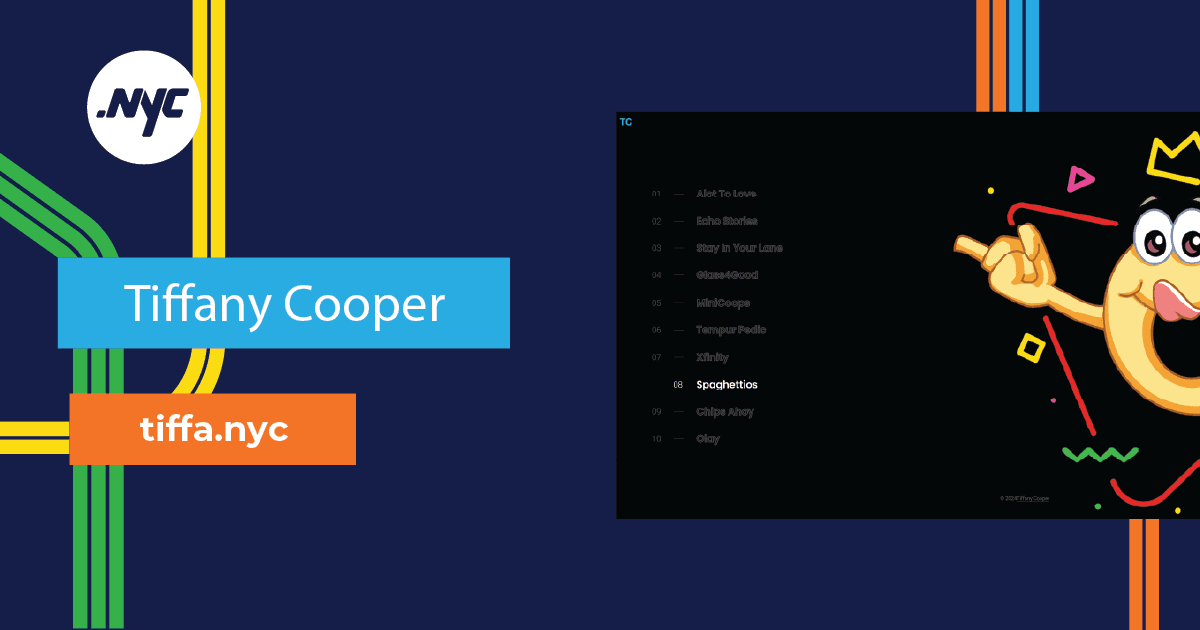
For Brooklyn-based art director Tiffany Cooper, that link is tiffa.nyc.
Her site functions as a curated body of work, giving collaborators a quick sense of how she thinks and the visual language she brings to a brief. As she puts it, “I turn sparks of ideas into living, breathing stories while blending motion, design, and a touch of fine art soul.” Visitors don’t spend long deciding whether to reach out, so the work has to communicate direction and craft almost instantly.
A dedicated website gives creatives control over that first impression. Platforms such as Instagram, Vimeo, and LinkedIn can support visibility, but they’re structured around feeds and updates rather than cohesive presentation. On your own site, you decide what leads, how projects are contextualized, and how your work evolves over time without being buried beneath newer posts or shaped by shifting algorithms.
It also shapes how opportunities move. Referrals often happen in passing conversations or forwarded emails, and the next step is usually someone typing what they think your URL is from memory. When that address is intuitive and easy to recall, interest turns into action quickly. When it’s complicated or forgettable, you introduce friction before a conversation has even started.
Why She Chose tiffa.nyc
Tiffany’s decision to use a .nyc domain was deliberate and personal. “I chose this because .NYC completes my name and literally spells out Tiffany C., making it feel personal and unique to me,” she explains.
That completion effect does practical work. “Tiffa dot NYC” reads as a name rather than a string of unrelated words, which makes it easier to remember after hearing it once. When it appears in an email signature, at the end of a reel, or on a pitch deck, it reinforces authorship and identity at the same time.
Because Tiffany is based in Brooklyn, her .nyc domain makes that proximity visible immediately. In a city where shoots, campaigns, and collaborations often move quickly, being local can influence who gets the call, especially when a team needs someone who can step in without travel logistics or delays. The extension signals that she’s part of the New York creative ecosystem and available within it.
She frames the choice in terms of ownership: “It’s more than just a domain, it’s a way to fully own my identity online and showcase my creative work as who I am.” A site like this often shapes whether someone decides to initiate contact at all, and the domain sits at the front of that experience.
If you’re choosing a domain for your own site, pick something people can recall after hearing it just once and that aligns naturally with how you introduce yourself. Don’t forget to think about how it will look on a proposal, on a business card, or at the bottom of a pitch deck—in a field where attention can be brief and decisions often move quickly, these small details can influence whether someone follows through. A domain that people remember increases the chances they’ll actually reach you.